Sunday, October 20, 2013

Promoting the Walkability of Austin and Ability of Kids to Play in the Streets

Neighborhood grassroots campaign in Austin to get city to install a stop sign
Neighborhood grassroots campaign in Austin to get the City to install a stop sign


In talking to Austin parents, many express frustration with how unsafe it is for their kids to walk to school, play in the streets, or access nearby amenities on foot. By no means is Austin unique in this regard. As a writer in the Atlantic Monthly lamented earlier this year: 
This is the point we have come to in much of the developed world: The freedom for a child to walk out the door and skip rope or play catch is something that has to be scheduled, organized, and officially permitted.

And for parents trying to get basic safety improvements installed, the process can be maddening, quickly leading to roadblocks and dead-ends.

Luckily, there are three great new developments that will help make our streets safer in Austin:

First, the Austin City Council has formed a new Pedestrian Advisory Council to help guide the City as it looks to improve walkability in the city. The Council, which is modeled on the City's Bicycle Advisory Council, meets for the first time this week on October 22nd, 5:30, at City Hall.

Second, Austin has a new grassroots coalition, WalkAustin, committed to transforming Austin into a pedestrian-friendly city.  Earlier this year, the coalition put on a walkability summit to launch a citywide conversation about promoting walking in the city.  As I understand it, the idea for creating the Pedestrian Advisory Council grew out of the summit.

Third, the National Association of City Transportation Officials (NACTO) recently released a set of new urban street design guidelines. The guidelines include a range of cutting-edge design guidelines for making streets safer and more inviting for people of all ages, as well as opportunities to carve out more active play spaces. As the NACTO website states:
Growing urban populations will demand that their streets serve not only as corridors for the conveyance of people, goods, and services, but as front yards, parks, playgrounds, and public spaces. Streets must accommodate an ever-expanding set of needs. They must be safe, sustainable, resilient, multi-modal, and economically beneficial, all while accommodating traffic.
The NACTO guidelines and Austin's new citizen-led efforts to increase walkability come at a perfect time for Austin, with its high pedestrian fatality rate and low walkability score. The national site, Walk Score, ranks Austin in the bottom half of large US cities on walkability--based on how easy it is to safely walk to basic household amenities such as grocery stores and restaurants. Both Dallas and Houston have higher rankings. 

Some of the new policies and programs I would love to see Austin adopt to improve walkability--and  the ability of families to walk and play in their neighborhoods--include:
  • A pilot project to retrofit 10 neighborhood streets across the city into shared streets, also known as living streets or homes zones. Through their design, shared streets place an emphasis on pedestrian scale and traffic calming, permitting children to play safety in front of their homes. The shared street concept, which originated as "woonerfs" in the Netherlands, has been adopted by cities throughout the world. NACTO's new design guidelines includes a section on shared streets. The City of San Francisco also has its own design guidelines for shared streets. Chicago is in the process of designing its first shared street. Santa Monica finished its first shared street transformation last year in a residential neighborhood where residents were concerned about crime and quality of life, in an effort to bring about a stronger sense of neighborhood and to promote walking and cycling. Aukland, Australia is putting in place the shared street concept throughout the city. Great Britain has funded the retrofitting of dozens of shared streets under its "Home Zone" program.  We came across many shared streets in our travels to Europe last summer (see pictures below).
  • Redesign the City of Austin's Pedestrian Program to more closely resemble the City's Bicycle Program, which has been able to cut across city silos and dramatically expand the city's cycling facilities through strong leadership and integration of planners and engineers. The Pedestrian Program is currently focused primarily on repairing and adding sidewalks to comply with the Americans Disabilities Act. In addition to addressing the critical gaps in sidewalk accessibility, the Program should be looking at other opportunities to increase pedestrian-oriented environments. Similar to the role of the Bicycle Program director, a Pedestrian Program director could serve as "walkability" advocate, to cut through city bureuacracy, proactively seek out opportunities to improve walkability, and build collaborations across departments.
  • In this same vein, the City needs a pedestrian master plan, building upon the city's sidewalk master plan, looking at a fuller range of opportunities to not only address accessibility but to also promote walkability in the City.
    shared street in San Sebastian Spain
    Shared street in San Sebastian, Spain
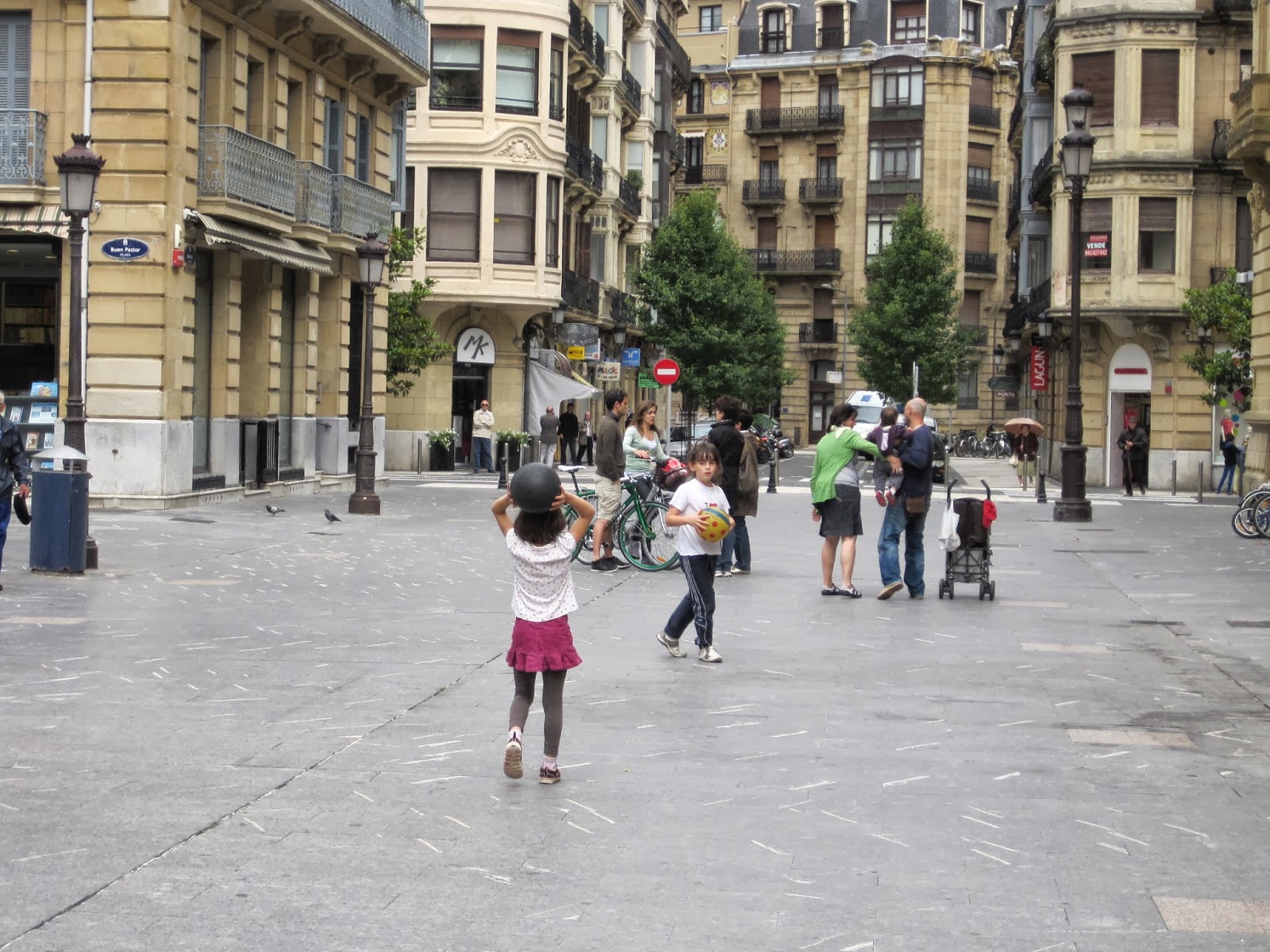
shared street in San Sebastian Spain
Shared street in San Sebastian, Spain


Pin It

Thursday, September 19, 2013

Austin Museum Day: Exploring Austin's Treasures with Kids

Austin's Bob Bullock Museum
This Sunday, September 22nd, is Austin's Annual Museum Day, a free, citywide discovery of museums in the area. I pulled up the list of participating museums and realized I had not heard of half of these museums. It looks like some are open just for this special day and are otherwise closed to the public.

Here are some of our family's favorite museums to visit with kids:

  • Texas Memorial Museum (this museum always reminds me of the 1970s; maybe it is all those dioramas lining the walls; it isn't the American Museum of Natural History or the Exploratorium by any means, but it's our only science museum for kids in the city so we'll keep happily visiting it)
  • Blanton Museum (offers several wonderful kids' programs)
  • Children's Museum (soon to re-open as the Thinkery)
  • Umlauf Sculpture Garden
  • Mexic-Arte Museum
  • LBJ Presidential Library (actually, I have been there but have not taken my kids yet; it is on our list!)
  • Lady Bird Wildflower Center
  • The Contemporary Austin

And here are some museums on the Museum Day list that I have never heard of before but am interested in checking out on Sunday with my kids:


2013 Austin Museum Day: List of Participating Museums


Pin It

Wednesday, September 11, 2013

Carving Out Urban Spaces for Parklets, POPOS, Pocket Parks, and More

When it comes to creating greater public access to parks and public spaces, there are lots of innovative things happening around the United States and world. Mexico City is transforming spaces under highways into public playgrounds and outdoor cafes, Pacoima, California, is transforming the lots of foreclosed homes into pocket parks, and Los Angeles has launched a "Streets for People" initiative to transform under-utilized areas of street scape into high-quality public spaces. The city is also working to create 50 new pocket parks in underserved communities.
Yerba Buena Gardens playground--built on the roof of the Moscone Center
Yerba Buena Gardens playground--built on the roof of the Moscone Center in San Francisco
On our family trip to San Francisco last month, we had lots of time to explore the city's wonderful parks, including the lovely Yerba Buena Gardens playground built on a rooftop (see above). (San Francisco, by the way, ranks second in the country on per capita spending for parks and recreation.)  I also had one morning to myself--a glorious 3 hours away from my kids--to observe first hand many other ways in which San Francisco has carved out dozens of new public spaces in a dense urban environment. This particular tour of mine focused on the city's parklets, POPOS, and alleys. More on alleys in a later post.

Parklets: San Francisco is the national leader when it comes to creating parklets--parking spaces that have been transformed into activated public spaces. Through the city's "Pavement to Parks" program, 38 parking areas have been converted into parklets since 2010, with the costs typically covered by the surrounding businesses. I visited about a dozen of these parklets during my walking tour, using a map created by SF Great Streets. None of the parklets I saw were being used as play spaces and did not seem targeted towards children at all. The primary uses for the parklets appeared to be extended outdoor dining and seating areas for adjoining businesses, along the lines of Austin's only parklet--the successful Royal Blue Grocery parklet on Congress Avenue. It seems like the parklet model is something that could also be used to carve out micro play spaces for children, along the lines of the pocket parks we saw in Barcelona last summer placed along major boulevards (see below), or the "urban" sandboxes I blogged about here.

parklet in San Francisco
Parklet in San Francisco
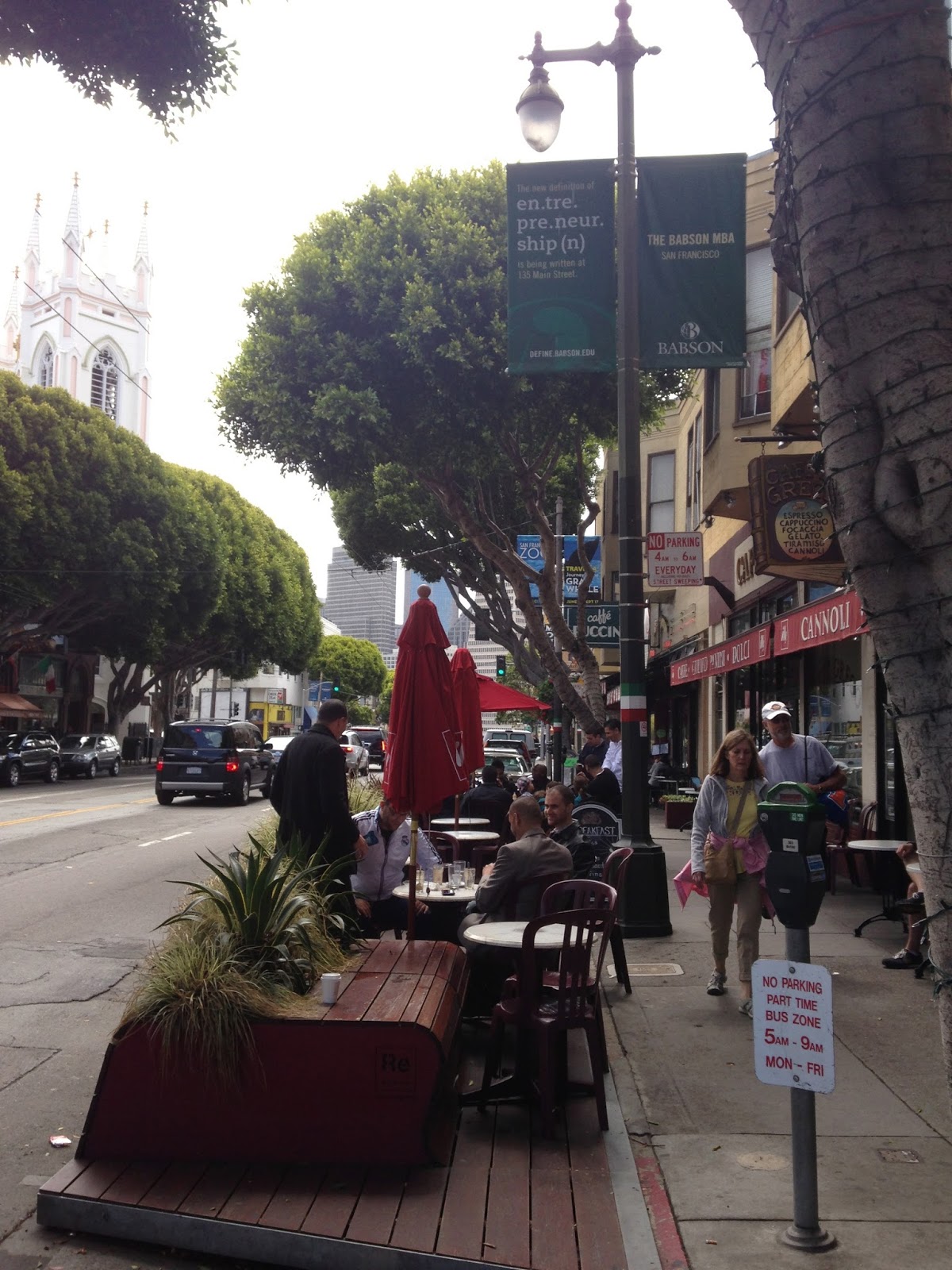
parklet in San Francisco Little Italy
Parklet in San Francisco--Little Italy
Pocket park for children in Barcelona
Pocket Park for Kids in Barcelona
POPOS: San Francisco has 68 POPOS, which stands for "Privately-Owned Public Open Spaces." I had never heard of this acronym before visiting the city. The open spaces range from parks and plazas to terraces, pedestrian walkways, and urban gardens--all of which are open to the public even through they are privately-owned and privately-managed. Many of the POPOS in San Francisco exist because of public open space requirements for new developments in the City's downtown plan. A local group has created a wonderful inventory of these spaces to raise public awareness about them, and there is even an interactive website (and soon-to-be app) with information about the POPOS. Here are a couple of the POPOS that I came across in San Francisco:
A Privately-Owned Public Open Space, or POPOS, at 555 Mission in San Francisco
POPOS pedestrian arcade and dining area at Embarcadero Center in San Francisco


Pin It

Tuesday, September 10, 2013

Austin's New Budget for Parks

Little Zilker Park
Little Zilker Park
The Austin City Council adopted its 2013-14 budget today. Good news on the parks front! The adopted budget includes $3.6 million in additional funding for parks, trees, trails, and swimming pools, thanks in large part to the grassroots advocacy of Great Austin Parks and supporters such as Councilmembers Tovo and Morrison. In the Trust for Public Land's most recent park survey, Austin ranks #54 in per capita spending for parks and recreation, with funding at $68 per resident, compared to the national median of $82. Even with the increase in parks funding adopted today, Austin will still likely rank in the bottom half of cities when it comes to per capita spending on parks and recreation. But with the vote today, we can hopefully nudge up a couple notches on the list (and since the new budget includes an allocation for 49 more police officers, maybe the existing parks will at least feel safer??).

Unfortunately, the budget adopted today does not do much to address another huge need in the city: creating new parks in underserved low-income neighborhoods. More than half of Austin residents are unable to access a park on foot (or wheelchair or stroller), including thousands of children in low-income areas of the city. Hopefully we can take greater strides to address that equity gap in next year's budget.

Tomorrow I will be posting on what some other cities, most notably San Francisco, are doing to creatively carve out new public open spaces.

Butler Park in Austin
Butler Park

Zilker Park kite day
Zilker Park
Pin It

Saturday, August 10, 2013

Discovering San Francisco's Public Art with Children

A second post on our recent San Francisco trip--this time on the delightful child-friendly art we found all over the city in public places and museums. In prior blog posts, I have written about the elements of child-friendly public art, including art that is tactile and interactive, engages a child's imagination and sense of wonderment, and is loved by people of all ages. Along those lines, here are some of the child-friendly art installations that we happened upon and fell in love with during our San Francisco trip:

Jonathan Borofsky Human Sculptures in San Francisco
Jonathan Borofsky's Human Structures
Plaza at 555 Mission Street
Shaking Man Statue in Yerba Buena Gardens
Terry Allen, Shaking Man Statue
Yerba Buena Gardens
Children flocking to touch the Shaking Man Statue


Trash Sweepers Clock at Exploratorium
Maarten Bass, Sweeper's Clock;
Exploratorium (must watch the video for this) 
Tinkerer clock at Exploratorium
Tim Hunkin, Tinkerer's Clock;
Exploratorium (see this website link for more info on this enchanting clock) 
Exploratorium 
Exploratorium musical lockers
Exploratorium's musical lockers
Yin Yang public art heads on Embarcadero in San Francisco
Robert Ameson, Yin Yang
Embarcadero in Justin Herman Plaza
Ugo Rondinone  Moonrise Sculptures
Ugo Rondinone's Moonrise Sculptures: March, October, and December
Public Plaza at 555 Mission
Rolling through the Bay toothpick exhibit at Exploratorium
Scott Weaver, Rolling through the Bay at the Exploratorium;
made with over 100,000 toothpicks over the course of 35 years;
the video for this piece has gotten over a million hits


Pin It

Friday, August 9, 2013

Cycling in San Francisco with Kids

The Which Way blog has been offline in vacation mode these past few weeks but is back now. After wrapping up a four-day visit to San Francisco, there are tons of things I am excited to post about the city. First up, cycling in San Francisco with kids:

Yesterday, our family went on the most gorgeous city ride we have ever been on before, cycling across the Golden Gate Bridge. In the morning, we rented bikes at the Embarcadero and then followed a popular and well-marked route, which took us along the waterfront, past Fisherman's Wharf and Crissy Field and then across the Golden Gate Bridge to Sausalito. We took the ferry from there back to the city.

There were a few parts of the ride that felt unsafe--those parts where the lanes were not buffered from a busy street or towards the end where we were sharing the road with cars--but otherwise the ride was glorious and very friendly for kids ages 8 and up if you are fine with walking up the steeper hills. Unmatchable views, great stops along the way, and no finer way to cross the Golden Gate Bridge. On the ride there we got to view the America's Cup boats in the bay, and we even came across a large group of kids participating in a week-long summer camp for exploring the city on bikes. Very cool! The only downer (aside from my kids bickering along the way) was at the end when we had to wait in line with hundreds of other cyclists for more than an hour to take the ferry from Sausalito back to San Francisco. Apparently, the key is to get to the ferry terminal earlier in the day to avoid the crush of cyclists arriving. As it was, we barely got back in time to return our bikes before the rental stand closed at 7pm. From another website, here is a summary of the route we took, along with good navigation tips.

In San Francisco, 3.5 percent of trips are by cycling, but the San Francisco Municipal Transportation Agency is aiming to increase that number to 8-10 percent by 2018, as part of a larger goal for half of all trips to be by sustainable modes of transportation. The agency's strategy to get there includes getting more families with kids to ride bikes, which means creating safer bike lanes, such as cycle tracks separated from cars. Like Austin, San Francisco is one of 6 cities taking part in the Green Lane Project to install more protected bike lanes throughout the city.

Here are some more pictures from our ride:

cycling with children in San Francisco
We started the ride on San Francisco's newly painted green bike lane along Embarcadero.  In terms of safety, I liked the green lane a lot better than no color on the pavement, but this part of the ride still made me nervous and required lots of supervision on my part since my youngest son is prone to weave in and out of his bike lane. I would have preferred to have seen some kind of buffer from the cars here.

This part of the ride was wonderful, with a shared bike-pedestrian path completely separated from cars.  Some parts of the path were marked off to separate the cyclists and pedestrians. In other parts, cyclists and pedestrians shared all of the path (see below), which worked out fine except for a couple instances when I had to warn my kids to watch out where they were going and to give pedestrians the right of way.

bike ride in San Francisco with children


cycling across the Golden Gate Bridge in San Francisco
Approaching Golden Gate Bridge
The ride into Sausalito
ferry ride back with bikes from Sausalito to San Francisco
Picking up our bikes on the ferry after our arrival back in San Francisco

Pin It

Wednesday, July 3, 2013

Is Austin the Most Expensive City to Raise a Family???

The local press is buzzing with news that Austin has become the most expensive city in the U.S. to raise a family. The news stories all cite a recent blog post on the Mint.com website, which refers to something called the Intuit Spending Index (Intuit, Inc., owns Mint.com). The blog post reports that Austin is the most expensive city to run a household, looking at consumer spending on education, groceries, and various household expenses. In addition to Austin, the other cities that made the top 5 list are:
  • San Francisco
  • Nashville
  • Seattle
  • Portland
Really? Is Austin the most expensive city to raise a family???  More than New York, Los Angeles, and Boston? No way.

I was unable to find much on the Intuit Spending Index and underlying methodology for developing the index, but what I was able to find does not support the press buzz. The Intuit Spending index is based on data provided by Mint.com users, who hardly seem representative of the average American family. (The Mint.com blog post does state that the data "has been analyzed and normalized to create a statistically relevant view that better represents the average American household"). The list also leaves out cities with populations of less than 500,000 and does not take into account housing costs.

Just as troubling is Mint.com's and the media's attempt to take how much households are spending on "running a household" and directly correlate that with how expensive a city is. The fact that the average household in Austin may be spending more than households in other cities on certain goods and services could be related more to the fact that households here are choosing to buy more household goods and services rather than to the relative cost of those items. Maybe Mint.com does not believe in its findings either, because another recent Mint.com blog post on the 7 most expensive cities in the U.S. does not include Austin. The blog post goes on to state that Austin is a cheap place to live.

Now, I also don't agree with any claims that Austin is a cheap place to live, especially not with our rising housing and utility costs. In other words, Austin is not the most expensive place to raise a family but also not the cheapest. I would bet that more reliable estimates would place Austin closer to the middle when comparing the costs in cities of raising a family. In the Cost of Living Index published by the Council for Community and Economic Research, for example, Austin ranks right below the national average when it comes to the cost of consumer goods and services for households.


Pin It