Saturday, June 30, 2012

CULTURAL OUTINGS WITH CHILDREN

Christopher Columbus's remains in Seville's Cathedral
If my children are going to last for longer than 30 minutes in a museum or other cultural outing, they need to be able to interact with their setting. Room after room of paintings, no matter how famous they are, is not going to cut it.  Nor for that matter is a beautiful gothic church, even if it does house the remains of Christopher Columbus. Truly, the best museums and other cultural sites are those designed for children and people of all ages.

We have visited some amazing kid-friendly and adult-friendly museums across Spain. Our favorites here:
  1. Navigation Museum, Seville
  2. International Puppet Museum, Alabama
  3. CosmCaixa Science Museum, Barcelona
  4. Archaeological Museum, Seville
Also high on the list: the Real Alcazar's labyrinth (in Seville) and counting how many areas we could find inside with 8-pointed stars. See below for pics from some of our favorites + some of our other cultural outings  + an additional geo quiz:


Navigation museum in Seville -- FABULOUS for people of all ages!
Amazing puppet museum in Albaida, Spain
Our friend Ann at the puppet museum

Barcelona's science museum


Which famous movie was filmed here?
Hint: Movie #5 in 6-part series, and it was pretty
horrible, but my kids loved it.

Labyrinth at Real Alcazar, Seville

Pin It

BIKING SEVILLE

Today, my oldest son and I rode around Seville on rental bikes. The city operates a bike rental program with easy pick-up and drop-off kiosks throughout the city but, unfortunately, these do not include bikes for children (at least not that we could find), so we had to track down a private rental facility.

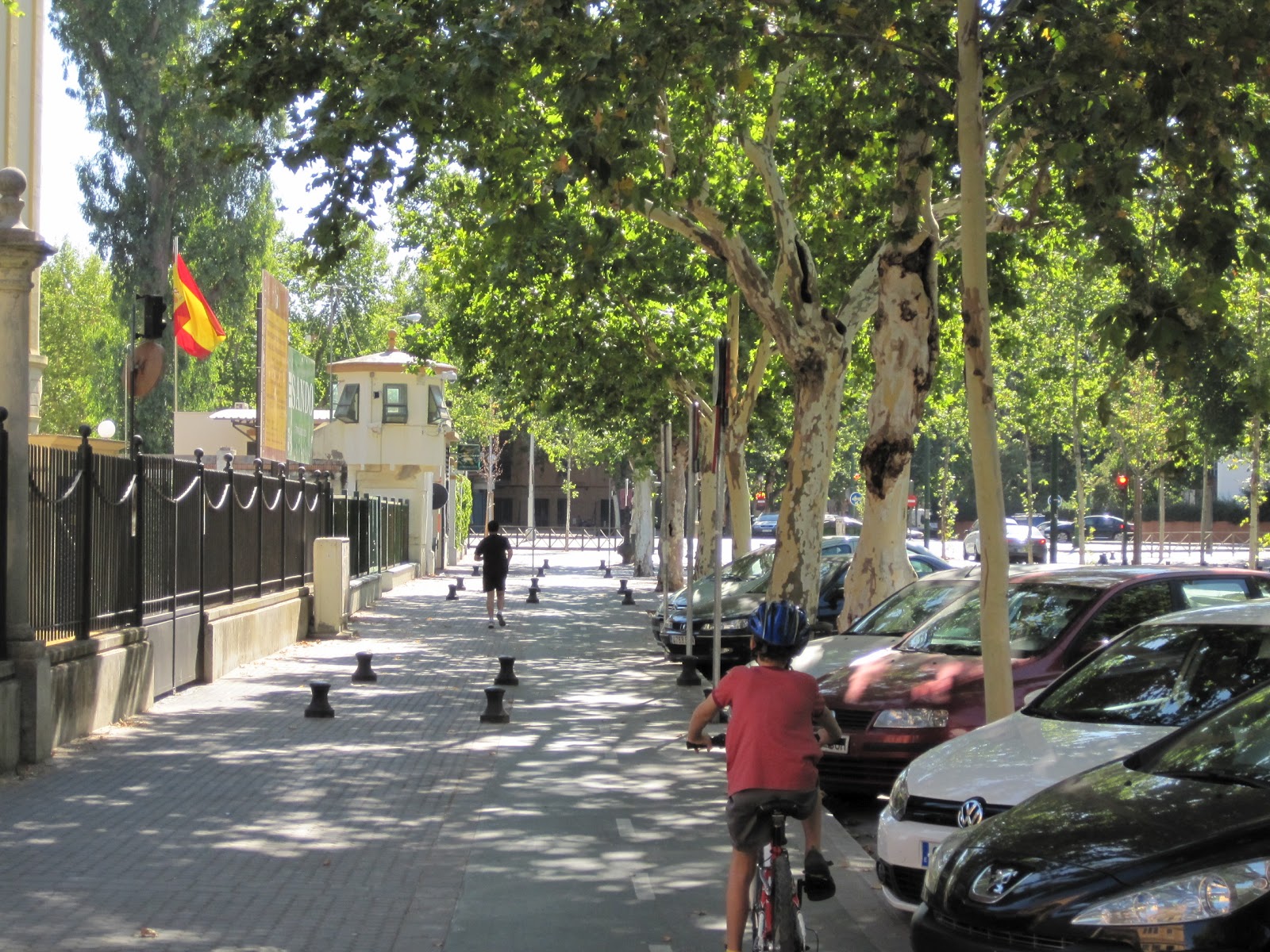
Like Barcelona and San Sebastian, we have found Seville to be a great city for biking with children. There are dedicated lanes for bikers throughout the city, and you can get pretty much anywhere you want to safely via bike. The temperature has dropped a bit but it is still scorching hot (the climate here is very similar to Austin's, although less humid and less annual rainfall). Luckily, we continue to find lots of shade here, even on our bike routes. Seville is filled with trees and other shade structures.

Interesting blurb from Wiki about the rapid development of Seville's bike route system:

"The most important factor beside Sevici bikes is that the municipality created more than 120 km of safe bike paths throughout the city and did it fast. Bi-directional green paths follow main avenues. They are continuous (properly connected at crossings), uniform (green surface, 2.5 m wide) and segregated from motorised traffic. Whole network cost 32 million Euros. Measures were based on sustainable mobility plan. Seville proves that development of cycling can be achieved fast."


And a great blog entry from People for Bikes on Seville's commitment to cycling. Apparently Seville's 87-mile network was built in just 3 years (2007-2009), and now 70,000 bike trips are made every day vs 2,500 in 2002.


family-friendly cities
Biking over the river. See the shade structures ahead.

cycle track for children
Dedicated bike lane on major thoroughfare


Most of the bike lanes we rode on were dedicated lanes on the sidewalk.

Pin It

Plazas as Places for People

One thing our time in Spain continues to remind of is the delightfulness of inviting and vibrant public spaces.  These are the essence of what make a city come alive and give it vitality.

Throughout our time in Spain we have come across so many wonderfully designed public spaces. One of our favorite types of public space is the public plaza, which come here in all shapes and sizes. These spaces, when designed well and located in the right places, are a treasure.

Even in the sweltering heat here in Seville, after the afternoon break or siesta, people fill these plazas to eat, visit, and play. They are a key driver of what makes Seville such a well-loved and lively city.  For my family with two rambunctious boys the most successful urban plazas:
  1. include seating
  2. incorporate shade
  3. address safety from any nearby vehicle traffic
  4. allow for rotating activities and performers
  5. include design elements that are engaging for children (such as rocks to hop across, statues to climb on, etc)
On the home front, urban planners just presented to the Austin City Council the concepts for a pilot form-based code for Airport Boulevard in Austin that will focus on improving the urban landscape along that corridor. What remains to be seen in the Airport Boulevard make-over is whether the city can figure out how to successfully incorporate vibrant public spaces that are attractive to residents of all ages. Here's to hoping that well-designed, family-friendly urban plazas are part of the make-over.

Neighborhood plaza adjoining the outdoor cafe we ate at last night.
There were several small kids who lived in an apartment next door  riding their bikes around. And other kids playing on the statute steps to the right.


Barcelona

San Sebastian


For more info on high quality public spaces:

Project for Public Places
Better Block
Seattle Center City for Families 
San Antonio (close to Austin, San Antonio has been doing lots of interesting work recently on transforming its downtown public areas into lively, family-friendly places).


Pin It

Wednesday, June 27, 2012

Fever, Heat, and Shade

We have all developed a serious fever during our time in Spain -- Euro Cup fever!  Right now the whole country is fervently celebrating the Spanish victory tonight in the semifinals. ¡Viva España!

We watched the first half of the game in a bar on Plaza De La Encarnacion, along with what seemed to be most of Seville's population. The plaza used to be a blighted car park lot but last year was transformed into a beautiful public square with an iconic and stunning building (Metropol Parasol). The Metropol, which is acclaimed to be the world's largest wooden structure, incorporates a ramp leading up to panoramic views of the city. But the central function of the building is to provide much-needed shade in a city that gets up to 110ºF in the summer. I had a hard time capturing the structure with my camera. Some better pictures are on this site.

Seville is incorporating other innovative types of shade as well, beyond just trees, such as the awnings in the picture below, which we have been finding covering many of the main pedestrian corridors in the central city. The addition of shade can help convert otherwise inaccessible areas of a city into lively plazas, parks, streets, and other gathering spots.

Since it is still so hot here, we cherish any respite we can get from the sun so that we can be out enjoying the city. Our trip here has really hit home for me how important shade is for creating active public spaces in a hot climate, and that there are lots of creative ways to provide for shade in addition to trees.

4 more days of Spain, and 5 more days until the Euro Cup Finals! Coming soon: more on plazas, Seville biking, and what makes for a child-friendly museum.

Before the soccer game in front of the Metropol Parasol
View of the Metropol from above

Part of the ramp at the Metropol leading to panoramic views of city
BTW: My oldest son, never one to go with the flow, decided two weeks ago that he was rooting for France. Even tonight, he insisted on wearing his France soccer outfit while we watched the game in the plaza, much to the chagrin of his parents!
Gotta love these awnings that provide shade in this shopping corridor.

Pin It

Sunday, June 24, 2012

POWER OF THE SUN

The Which Way blog is back in commission after being outside a WIFI zone the past several days. We arrived in Sevilla today, which we quickly discovered is sweat-drippin HOT.  The summer climate here is similar to Austin's. 110˚F today. Ugh.

Notwithstanding the heat, we will be testing out the streets, bike routes, and parks here over the next week. I hope to post some blogs here on how Austin and Seville compare with their child-friendly orientation. A great story ran on KUT a couple of days ago on a similar topic: whether Austin's downtown is poised to become more family-friendly.

One thing that makes a huge difference to a downtown being family-friendly is shade from the sun, especially in this heat. Hot streets means hot children and melt-downs trying to get anywhere. The best streets are those with shade cover, whether natural or man-made, although here's to more trees.


On the topic of the sun, an interesting tidbit about Spain is that it is home to the world's first commercial solar power tower, located just outside of Seville. The tower, which was constructed in 2007, is part of a series of solar power generation plants to be constructed in the area utilizing the latest technology. You can read more about it here.  Spain has been a worldwide pioneer in green energy (in 2010, 18% of the country's power was from wind and solar), which was evident in all of our drives across Spain, where we saw field after field of wind towers and solar panels. However, the subsidy programs used to help fund the power have been very controversial here, especially with the country's economic woes, leading the Spanish government to recently halt the subsidy programs.

One of the many wind power fields we passed on our drives through Spain.


Pin It

Tuesday, June 19, 2012

OPEN SPACE IN DENSE CITIES: COURTYARD HOUSING

We spent today in Granada touring the Alhambra and walking through city. One of the things that struck me today is how dense the housing is here, but yet how much access there still is to high quality open space, which is key keeping children happy and healthy in a dense urban setting. Two key contributions to open space here: courtyard housing and plazas. More on plazas in a future blog. For now, a bit on courtyard housing:

As you can see from the picture below (if you look closely at least), much of the older housing here in Granada was developed around a central private courtyard. The houses were originally occupied by one family, most likely, but now typically consist of several apartments that all share the common courtyard.

Courtyard housing is a style of housing that dates back many thousands of years to some of the earliest urban settlements and was common in ancient Roman times as well as Islamic architecture. What excites me about courtyard housing is its resurgence in newer apartment developments as a way to provide high quality and safe access open space for families living in a dense urban setting (a small balcony doesn't cut it). As a reporter from the L.A. Times wrote in an excellent article 7 years ago, "The courtyard apartment is an idea whose time has come back. Amid today's high-rise building trend, the need for such urban oases -- infused with a communal spirit -- is greater than ever."  I am especially excited about the opportunities to develop more of these courtyards in Austin in a way that is attractive enough to draw families with children back to the urban core.

The City of Portland even hosted a design competition to induce more development of this form of housing for families with children. There are many other examples of "courtyard apartments" across the U.S. and Europe, including these from Copenhagen and San Francisco.

More photos below from our time in Granada today, which centered on a tour of the Alhambra and then recovering from our tour of the Alhambra. The Alhambra is a enormous complex of palaces and fortresses constructed and occupied by the Islamic rulers of Granada starting in the 1300s (until the Catholic monarchs, Queen Isabella and King Ferdinand and their forces, drove them out in 1492). The pictures below really can't do justice to capturing the immensity and beauty of the Alhambra. For more info on the Alhambra and its historical and architectural significance, here is a wiki link.  Oh, and I don't want to forget adding this: Bill joined us yesterday. We are thrilled to have him here with us.

A photo from the courtyard of one of the palaces at the Alhambra.

The walls of the palaces were covered in these
beautiful engravings.

Another photo from one of the Alhambra palaces.


Our tapas intake for the day: manchego cheese, gaspacho, and jamon with melon.
Pin It

Tuesday, June 12, 2012

BIKING SAN SEBASTIAN, PART II

After our Spanish lessons this morning we set out on another bike ride in San Sebastian, appreciating the fact that the temperature here today was 65ºF.  I have written prior posts on this blog about our first biking experience in San Sebastian as well as Barcelona. A lot of the bike lanes here are "cycle tracks," which are intended to be used exclusively for bicycles and are safely separated from vehicle travel lanes, rather than solely adding paint striping onto the same roadway used by cars. Cycle tracks are super family-friendly. I yearn for more of these in Austin! Truly yearn. We rode our bikes around San Sebastian today for 3 hours, primarily on the city's cycle tracks. One of the key safety features of the cycle tracks here is the use of bollards where the bike lane runs on the street. With the use of these, even when we were riding right next to cars, I felt like my children were safe. The bollards here appear to be plastic, so I assume they would be fairly reasonably priced to install.


In front of our apartment.


Cycle track separated from road via a curb cut.
Late lunch stop. Yes, he ate the whole sandwich,
although not in one sitting.

Plastic bollards separate bike riders here
from vehicular traffic.


Close up of a bollard.


Daily gelateria stop -- which is why we had to bike for 3 hours!


Great publication on cycle tracks prepared for Portland's regional government, analyzing best practices for cycle tracks, including findings from Amsterdam and Copenhagen: Cycle Tracks: Lessons Learned.
Pin It