Showing posts with label great streets. Show all posts

Sunday, July 19, 2015

Cycling and Safe Streets in Amsterdam: A Movement Sparked by Parents and Children

cycling in Amsterdam with children
Bicycle parking garage in Amsterdam
My family recently returned from a trip to Amsterdam, where we got to try out cycling in one of the most bicycle-friendly cities in the world. When we exited the train station, we were greeted by a multi-story parking garage clogged with more than 3,000 bikes, a now famous landmark in Amsterdam, reflecting how predominant cycling is here. Approximately 38% of all trips in Amsterdam are by bike compared to 2-3% in Austin.

I have been reading up about how these infrastructure changes came about. This video chronicles Amsterdam's history as a cycling city, pointing out that Amsterdam has not always embraced cycling like it does today. In the 1970s, after a record number of children were killed on Dutch roads, Dutch parents and their children led mass protests and organized around the country, demanding a transportation policy that prioritized safe streets.

family-friendly cycling in Amsterdam
Cycling in Amsterdam
While much attention has been given to how this fierce activism helped launch the construction of the nation's world-famous cycling infrastructure, families across the Netherlands worked for much more than that.  A wonderful documentary from 1972 captures how Dutch families have taken to the streets for a whole range of measures to make streets safer for children in dense urban areas. The Dutch government responded by creating play streets, "street corner havens," car-free Sundays, and an array of other traffic calming measures.

One of Amsterdam's biggest infrastructure challenges today is, ironically, addressing the deluge of bikes that fill the streets. Before our trip, a Dutch friend had warned us to not cycle in Amsterdam with children in the busy urban core unless they were super experienced urban cyclists.  It is true that making the jump to cycling in Amsterdam for my family was, well, terrifying at times. Sort of like going from driving a car in a small town to an L.A. freeway. My preteen children had to learn on the fly that they could absolutely not stop, much less slow down, while we were cycling in rush hour cycling traffic. And this was while cycling without helmets (no one wears them in Amsterdam and they were unavailable at the bike rental shop). The worst part was avoiding the speeding mopeds that weaved in and out of cyclists in the cycle lanes—apparently a widespread problem in the city. Luckily, it sounds like the government recognizes this is an issue and is working to ban mopeds in cycle paths.

Speeding mopeds and rush hour traffic aside, overall we were extremely impressed with Amsterdam's cycling infrastructure—an incredible opportunity to try out in person what we can aspire to here in Austin. The dedicated cycle lanes, the cycle-centric street crossings, the traffic lights for bikes, the ubiquitous bike parking facilities, and more. All these things were a delight to see in person.

Today, the Netherlands' traffic fatality rate is 60% lower than it was when parents and others first set out to advocate for safer streets. Meanwhile, Austin's traffic fatalities are on track to be a record high this year.  It is good to keep in mind the experiences of the Netherlands in making its street safer: that changes are more than possible, but they will not come about until the public demands them.


Off-street cycling lanes in Amsterdam

Cyclists even have their own lights!

cycling in Amsterdam through the Rijksmuseum
A highlight: cycling through the famous Rijksmuseum

More dedicated cycling lanes with nice big buffers from the street


Pin It

Monday, May 26, 2014

When to Allow Your Children to Navigate Austin's Streets Alone on a Bike?

cycling on South Lamar with a child
Cycling with my son down South Lamar: Not for the faint of heart!

As my sons approach their teens, they are wanting something I had as a kid: the ability to explore their neighborhood on bikes without their parents hovering over them.

A typical arterial street in our neighborhood.
Lots of parked cars, leaving no room for two cars to pass each other,
let alone two cars and a cyclist.
But our inner-city neighborhood streets today are not like the quiet streets in the suburbs where I grew up. Today, our streets are crowded with parked cars and traffic while lacking basic pedestrian and cycling infrastructure. Our kids have to regularly navigate weaving in and out of parked cars while distracted drivers speed by them. When there are sidewalks (which are rare), the kids must confront huge cracks, uneven pavement, and missing curb cuts.  It's one thing to navigate these hazards as a 40-year-old with many years of experience cycling, and another thing when you are 9.

Our neighborhood is by no means alone in this regards in Austin.  Throughout the city, parents must regularly confront this question: At what point is it safe enough to let your child ride his bike or scooter without an adult nearby?
One of our rare neighborhood sidewalks.
Notice the lack of curb cuts.

Six years ago, Lenore Skenazy wrote a controversial article about how she let her 9-year-old son ride the New York subway home alone. This sparked a national conversation about parents becoming too obsessed with theirs kids' safety, stripping kids of the independence that they need to grow into healthy, confident adults. More recently, an article by Hanna Rosin criticized parents' pre-occupation with safety and cites evidence that links the loss of children's ability to engage in independent, risk-taking discovery  to increases in "depression, narcissism, and a decline in empathy."

Both of these articles, however, ignore the hazards we observe everyday as we travel through our neighborhoods: absent-minded drivers who text, ignore crosswalks, and regularly speed through our neighborhood streets. Rosin asserts that the world is not a more dangerous place than it was when we were growing up, but she bases her argument solely on crime stats and child abduction rates, not on traffic safety. Meanwhile, pedestrian fatalities have been on the rise. A pedestrian is injured every 8 minutes in a traffic crash in the United States, and 19% of these injuries are to kids 15 and younger. Pedestrian injuries are the second leading cause of accidental death among children 5 to 15. 

I wonder if I would feel more comfortable letting my kids ride a New York City subway alone than, say, riding their bikes or walking to their local library. I might. According to a report released last week by Smart Growth America, the Austin metro area is the 24th most dangerous region for pedestrians (and probably not any better for cyclists); New York City is 48th (out of 51 metro areas). To get to our neighborhood library, my kids have to navigate several hazards, including crossing a very busy and dangerous intersection on South Lamar where I regularly see cars turning left that fail to yield to oncoming cars, let alone pedestrians and cyclists. (Here's a link to a prior post about our cycling adventures together on South Lamar).

All this being said, I think that ultimately the decision about whether to let your child ride his or her bike alone is a very personal one. It depends on the conditions in the neighborhood, as well as the child's cognitive abilities and experience riding with adults and learning good cycling safety judgment. What also helps: a leap of faith, a kiss on the cheek, and maybe a prayer or two. 

The cast from the broken arm!
Taking all these things into account, last month we finally decided our kids were old enough to go off alone on their scooters to buy snow cones on the edge of the neighborhood.  The outcome? Did our kids survive? Yes. Although my oldest son's scooter hit a big piece of broken pavement in the sidewalk, causing him to fall and break his arm. I kid you not.

Will we let our children ride alone again? Yes, although next time I will remind them to look out for the cracks in the sidewalk.
Here's the uneven pavement that was the source of the fall and broken arm.
This is very typical of the state of neighborhood sidewalks in Austin.
Despite several calls to the City of Austin, this sidewalk has still not been repaired.


Pin It

Tuesday, February 18, 2014

Assessing Austin's Community Character Part II

I have received some flack for my recent post on Assessing Austin's Community Character, where I presented what I love about my neighborhood: access to yards for children; our neighborhood school and park; affordable, family-friendly restaurants; access to parks and athletic facilities; the eclectic, artistic, and diverse character; nature; and -- gasp -- cul-de-sacs!  One commenter wrote that I was "clinging to some ideal of bungalows with huge yards," while another wrote that I was asking for "suburban amenities."

What some pro-densification readers have probably taken the most offense at was my reference to yards and cul-de-sacs.  But, actually, these concepts of safe, kid-friendly, outdoor play spaces are not antithetical to living in a dense urban area. 

One of my main purposes in creating this blog has been to call out examples from around the world where cities are successfully providing opportunities for families to live in denser housing with the amenities that these commenters have characterized as "suburban."

family-friendly courtyard housing in Zurich
Courtyard housing in Zurich
For example, let's take yards. I have written several blog posts about housing designs from around the world, such as row houses and courtyard housing, that provide denser urban housing AND access to yards for children. For example, here is a picture from a post I wrote in 2012 about courtyard housing in Zurich. My sister-in-law used to live in this particular housing development, which provided a huge shared yard where kids (and adults) could safely play.  In Los Angeles, these complexes are called garden courts. 

Vancouver, which has one of the densest downtowns in North America, requires that 25% of units be designed and sold/rented to families with children. As a result, throughout downtown Vancouver you can find housing towers surrounded by wrap-around, three-story townhouse units with access to secure playground yards for children. (Through my service on the Downtown Commission, I recently advocated for Austin to adopt a first-step, scaled-down version of this policy for downtown by giving density bonuses to developers who include small outdoor play areas for children. The Commission unanimously voted for the policy, which the Austin City Council approved on first reading last week. City staff is currently opposed to the proposal).

Vancouver housing for families with children
Vancouver
In the same vein as Vancouver, Portland, Oregon's highly-dense Pearl District has a goal for 25% of the housing units to be family-friendly. In 2011, I visited one apartment complex there that has followed the courtyard concept, as well as other housing complexes that are directly adjacent to kid-friendly parks. 


Portland Pearl District and housing for families with children
The Pearl District in Portland, Oregon
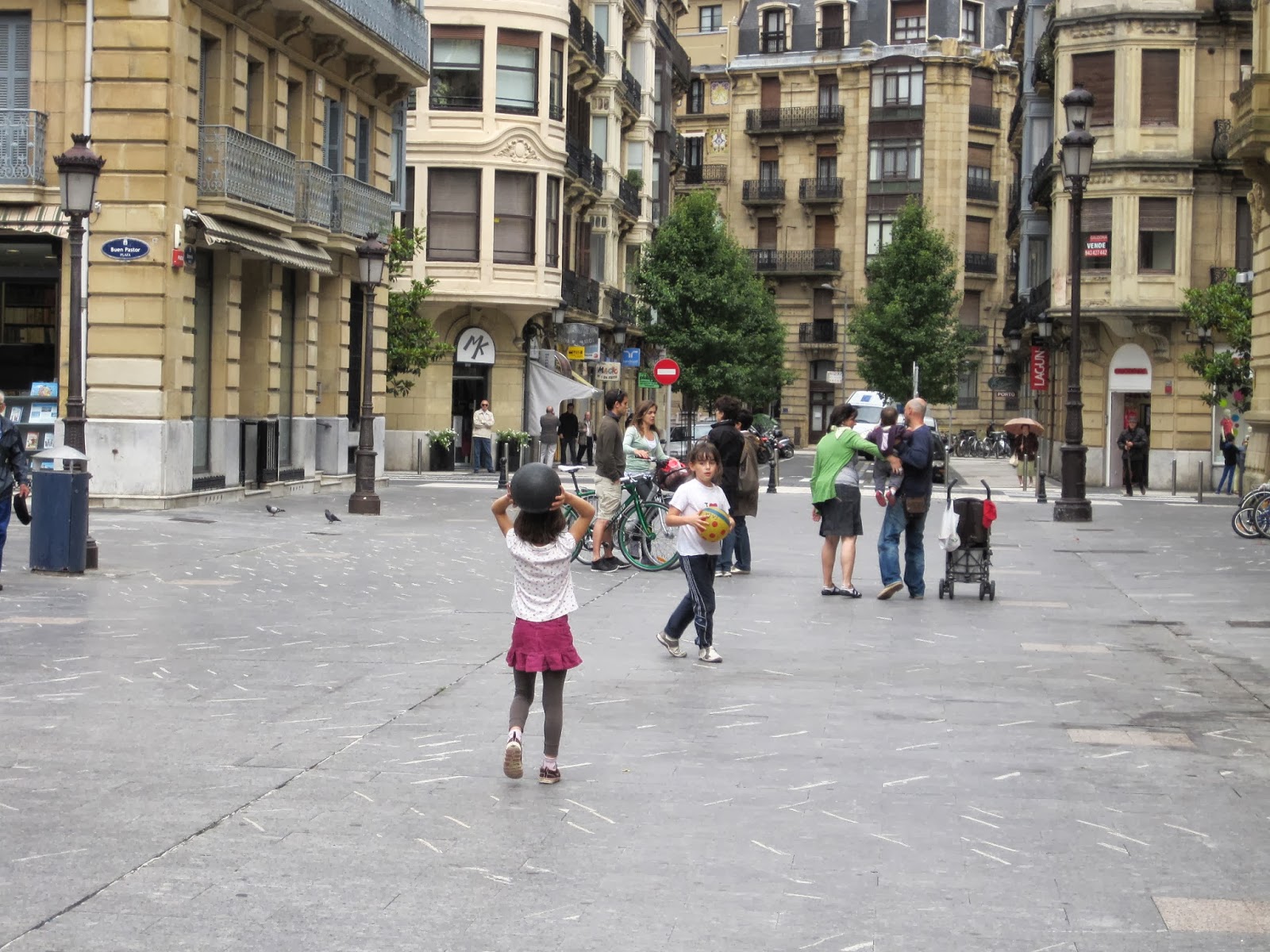
As for safe streets where kids can throw a ball or ride their bikes, while admittedly cul-de-sacs are not ideal for a denser urban core, there are many models of streets in dense cities that facilitate kids' ability to play. The woonerfs in Denmark and Sweden are probably the most well-known model. In London, these are known as home zones and are being retrofitted throughout the city. In the U.S., these have been referred to as "shared streets" or "living streets." Here is a picture of a wonderful shared street my family visited in San Sebastian, Spain in 2012. 
shared streets for children to play
Shared Street in San Sebastian, Spain
What worries me about the negative responses I have received to my previous post is that they may represent a more widely-shared expectation in our city: that we can only have a denser urban core if we sacrifice the things that many of us love most about our communities--such as yards, trees, and safe streets. My hope for CodeNext is that our city policymakers recognize that these family-friendly amenities are not only complementary but actually critical to creating a city that is robust, healthy, and sustainable for all types of households.
Pin It

Friday, January 24, 2014

Assessing Austin's Community Character

Austin's CodeNEXT team (the team that is leading an overhaul of the City of Austin's land use code) is currently conducting an assessment of our city's community character. The team wants to know what the Austin public values about our neighborhoods, favorite places, and opportunities for improvement, with a focus on the built environment.

There is a final city workshop tomorrow where Austinites can offer their input on the community character assessment, and then later this month the City will be rolling out a "do-it-yourself" Neighborhood Community Character kit.

I hope that lots of Austin's families are weighing in on this assessment. What about our neighborhoods' unique character supports families' ability to raise children, and what makes it hard to raise children?  What do we like and not like about our homes, our streets, our public spaces, and our businesses?

Here is my (partial) list of things I love about my community's character, with a focus on the things in my neighborhood that contribute to my family's happiness and well-being. What does your list look like? 

1. Yards: I love my neighborhood's backyards and front yards. With the focus on densifying Austin's urban core, what often gets lost is the importance of providing safe places for kids to engage in free play outdoors. Outdoor play is a critical part of a child's development and a parent's sanity. In a household with two rambunctious boys, I don't know how we could have survived raising kids so far without being able to send our kids outdoors to run around and play--while also being able to keep a close eye on them when cooking dinner, working at home, etc.  In fact, the only reason I have been able to write this blog post today (since school was cancelled) is because I could send my kids and their friends into the yard to play.

2. Neighborhood school and park. When we first bought our house, before we had children, we did not realize at the time what a blessing it is to live within walking distance of an outstanding neighborhood school that was next to a park. Now that we have school-age kids, we are thankful everyday for living so close to such a community treasure that we can walk and bike to each day. Beyond the educational benefits, both our neighborhood school and park have fostered tons of new friendships with our neighbors, a greater sense of neighborhood identity, and community stewardship. 

3. Affordable, family-friendly restaurants. When my kids were younger, it was important for us to be able to go to restaurants with outdoor play areas for children. Now that my kids are older, a family-friendly restaurant is one that serves affordable, healthy, and kid-friendly food within walking or cycling distance of our home. 

4. Access to parks and athletic facilities.  I love the fact that my neighborhood is close to great parks as well as athletic facilities where our kids can play baseball, soccer, tennis, and more.

5. Eclectic, artistic and diverse character. I love living in a neighborhood where my 80-year-old neighbor can grow a field of corn in his front yard, where there are art cars parked in the driveways, and where multiple generations live on a street. I cherish the fact that our neighborhood includes affordable housing, including public housing for families and MHMR housing for persons with mental disabilities. And I appreciate all the artwork in the neighborhood, including the hand-knitted artwork on the stop sign pole, the mural in the alley, and other artwork gems that pop up in nooks and crannies throughout the hood.

6. Cul-de-sacs. While cul-de-sacs are generally shunned in urban planning circles, I love my neighborhood's cul-de-sacs.  Our cul-de-sacs offer the safest places for kids to play in the streets, learn to ride their bike, shoot hoops, roller skate, and more. Studies have found that cul-de-sacs result in a substantial increase in play activity compared to an open grid street pattern, and the Atlantic Cities recently ran this great article on how cul-de-sacs increase social interaction among neighbors. Here's to the cul-de-sac!

7. Back to nature. I love going to sleep at night to the sound of an owl hooting in my back yard, and then waking up on in the morning to the sound of a woodpecker. I love the canopy of trees that line our streets, the butterflies that appear in our flower beds, and the lizards that appear on our front porch.


Pin It

Sunday, October 20, 2013

Promoting the Walkability of Austin and Ability of Kids to Play in the Streets

Neighborhood grassroots campaign in Austin to get city to install a stop sign
Neighborhood grassroots campaign in Austin to get the City to install a stop sign


In talking to Austin parents, many express frustration with how unsafe it is for their kids to walk to school, play in the streets, or access nearby amenities on foot. By no means is Austin unique in this regard. As a writer in the Atlantic Monthly lamented earlier this year: 
This is the point we have come to in much of the developed world: The freedom for a child to walk out the door and skip rope or play catch is something that has to be scheduled, organized, and officially permitted.

And for parents trying to get basic safety improvements installed, the process can be maddening, quickly leading to roadblocks and dead-ends.

Luckily, there are three great new developments that will help make our streets safer in Austin:

First, the Austin City Council has formed a new Pedestrian Advisory Council to help guide the City as it looks to improve walkability in the city. The Council, which is modeled on the City's Bicycle Advisory Council, meets for the first time this week on October 22nd, 5:30, at City Hall.

Second, Austin has a new grassroots coalition, WalkAustin, committed to transforming Austin into a pedestrian-friendly city.  Earlier this year, the coalition put on a walkability summit to launch a citywide conversation about promoting walking in the city.  As I understand it, the idea for creating the Pedestrian Advisory Council grew out of the summit.

Third, the National Association of City Transportation Officials (NACTO) recently released a set of new urban street design guidelines. The guidelines include a range of cutting-edge design guidelines for making streets safer and more inviting for people of all ages, as well as opportunities to carve out more active play spaces. As the NACTO website states:
Growing urban populations will demand that their streets serve not only as corridors for the conveyance of people, goods, and services, but as front yards, parks, playgrounds, and public spaces. Streets must accommodate an ever-expanding set of needs. They must be safe, sustainable, resilient, multi-modal, and economically beneficial, all while accommodating traffic.
The NACTO guidelines and Austin's new citizen-led efforts to increase walkability come at a perfect time for Austin, with its high pedestrian fatality rate and low walkability score. The national site, Walk Score, ranks Austin in the bottom half of large US cities on walkability--based on how easy it is to safely walk to basic household amenities such as grocery stores and restaurants. Both Dallas and Houston have higher rankings. 

Some of the new policies and programs I would love to see Austin adopt to improve walkability--and  the ability of families to walk and play in their neighborhoods--include:
  • A pilot project to retrofit 10 neighborhood streets across the city into shared streets, also known as living streets or homes zones. Through their design, shared streets place an emphasis on pedestrian scale and traffic calming, permitting children to play safety in front of their homes. The shared street concept, which originated as "woonerfs" in the Netherlands, has been adopted by cities throughout the world. NACTO's new design guidelines includes a section on shared streets. The City of San Francisco also has its own design guidelines for shared streets. Chicago is in the process of designing its first shared street. Santa Monica finished its first shared street transformation last year in a residential neighborhood where residents were concerned about crime and quality of life, in an effort to bring about a stronger sense of neighborhood and to promote walking and cycling. Aukland, Australia is putting in place the shared street concept throughout the city. Great Britain has funded the retrofitting of dozens of shared streets under its "Home Zone" program.  We came across many shared streets in our travels to Europe last summer (see pictures below).
  • Redesign the City of Austin's Pedestrian Program to more closely resemble the City's Bicycle Program, which has been able to cut across city silos and dramatically expand the city's cycling facilities through strong leadership and integration of planners and engineers. The Pedestrian Program is currently focused primarily on repairing and adding sidewalks to comply with the Americans Disabilities Act. In addition to addressing the critical gaps in sidewalk accessibility, the Program should be looking at other opportunities to increase pedestrian-oriented environments. Similar to the role of the Bicycle Program director, a Pedestrian Program director could serve as "walkability" advocate, to cut through city bureuacracy, proactively seek out opportunities to improve walkability, and build collaborations across departments.
  • In this same vein, the City needs a pedestrian master plan, building upon the city's sidewalk master plan, looking at a fuller range of opportunities to not only address accessibility but to also promote walkability in the City.
    shared street in San Sebastian Spain
    Shared street in San Sebastian, Spain

shared street in San Sebastian Spain
Shared street in San Sebastian, Spain


Pin It

Tuesday, March 5, 2013

Sandboxes in Cities

I am have been thinking about sandboxes in cities. Summer is still a few months away, but the weather here in Austin has been gorgeous, and, whenever possible, my family wants to be outdoors. There are very few things that will entertain my two sons -- for hours -- more than sand, dirt, and rocks.

Other cities have decided that, if you live in a city and cannot make it to the beach, bring the beach to you! I love the temporary and permanent installations of sand boxes in the cities featured below. Sandboxes are a fabulous way to draw families into the downtown urban core and a fun way to transform streets that are otherwise dead on the weekends into places of play.


Sandbox Project in Canada for children downtown
The Sandbox Project, Ottawa, Canada
Epoch Times, June 14, 2012
temporary sandbox in New York City Summer streets project
New York City, Summer Streets
© Nellies 78, Flikr, available under a Creative Commons Attribution/Noncommercial License
 
Imagination Playground sandbox in NYC
New York City, Imagination Playground

Paris Plage giant sandbox
Paris Plage
 © Cedric Cousseau, Flikr, available under a Creative Commons Attribution/Noncommercial/No Derivative Works License

sandbox for kids in summer streets in New York City
Summer Streets, New York City
© nycstreets, Flikr, available under a Creative Commons Attribution/Noncommercial License

temporary sandbox downtown
© akseabird, Flikr, available under a Creative Commons Attribution/Noncommercial License 
Pin It

Sunday, June 24, 2012

POWER OF THE SUN

The Which Way blog is back in commission after being outside a WIFI zone the past several days. We arrived in Sevilla today, which we quickly discovered is sweat-drippin HOT.  The summer climate here is similar to Austin's. 110˚F today. Ugh.

Notwithstanding the heat, we will be testing out the streets, bike routes, and parks here over the next week. I hope to post some blogs here on how Austin and Seville compare with their child-friendly orientation. A great story ran on KUT a couple of days ago on a similar topic: whether Austin's downtown is poised to become more family-friendly.

One thing that makes a huge difference to a downtown being family-friendly is shade from the sun, especially in this heat. Hot streets means hot children and melt-downs trying to get anywhere. The best streets are those with shade cover, whether natural or man-made, although here's to more trees.


On the topic of the sun, an interesting tidbit about Spain is that it is home to the world's first commercial solar power tower, located just outside of Seville. The tower, which was constructed in 2007, is part of a series of solar power generation plants to be constructed in the area utilizing the latest technology. You can read more about it here.  Spain has been a worldwide pioneer in green energy (in 2010, 18% of the country's power was from wind and solar), which was evident in all of our drives across Spain, where we saw field after field of wind towers and solar panels. However, the subsidy programs used to help fund the power have been very controversial here, especially with the country's economic woes, leading the Spanish government to recently halt the subsidy programs.

One of the many wind power fields we passed on our drives through Spain.


Pin It

Tuesday, June 12, 2012

STREET GEEK

We are on week two of our time here in San Sebastian. Having a second week here is a luxury and has allowed us to slow down on cramming in tourist activities and to live more in sync with the rhythm of the city.  We have finally honed in on our favorite gelateria and our top 3 favorite bakeries.


One of the traditions here in San Sebastian that we have been taking on is the afternoon stroll. After school and work get out, the residents go on walks together throughout the city center. We love this tradition. I still cannot get enough of the streets here, which allow us to walk and even play safely in a highly urbanized setting.

There are streets where cars have the right of way, and other streets that are open to cars but where pedestrians have the right of way (such as the street where our apartment is located -- see the first picture below).  And then there are streets which are completely closed to cars for certain times of the day (or at all times).  These latter two categories of streets are alive with people during the afternoon strolls as well as into the night. 

The strong pedestrian orientation furthers a robust retail environment, along with a high level of social interaction. I love the practice here of designing streets as social spaces. On the play front, we saw lots of children riding their trikes and playing ball in the streets, especially in the larger plaza-like areas.

family-friendly streets
Pedestrians have right of way here

A block from our apartment.


 Another block over, cars have right of way
on this street,...

...but my kids can still safely cross.

kid-friendly plaza
Kids playing ball in plaza-like street.

Soccer in the street.


Here are some links I quickly found on designing family-friendly streets:

Pin It